
Lawyers | ||||
|---|---|---|---|---|
|


 Reforming Maternity Protection in India: New Dimensions under the Code on Social Security, 2020
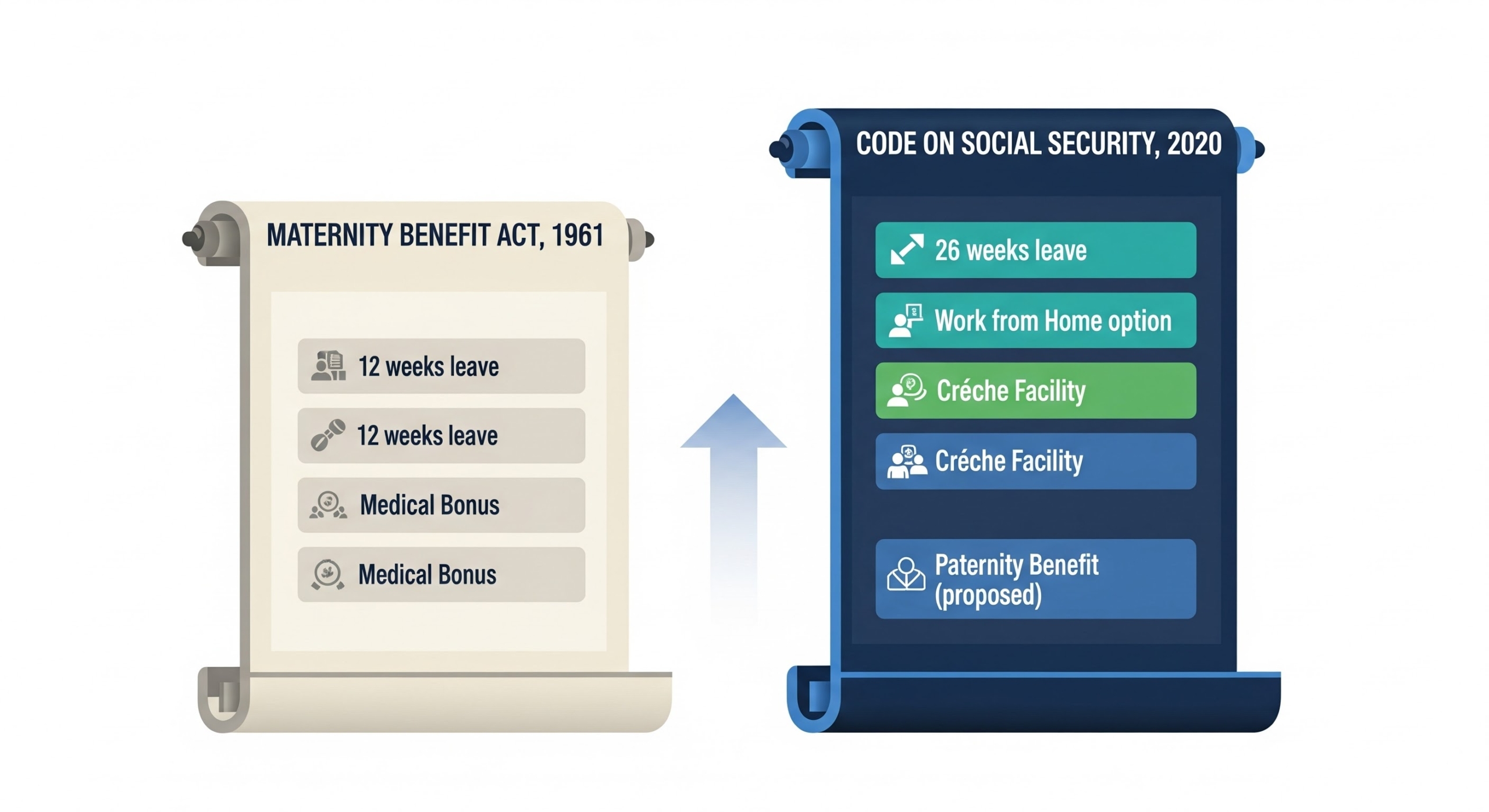
The Maternity Benefit Act, 1961, which earlier functioned as an independent legislation, has now been subsumed into the Code on Social Security 2020 as part of the Government comprehensive labour law reform. This integration is a significant step towards consolidating 29 existing labour laws into four broad labour codes, aimed at simplifying compliance, enhancing social security coverage, and strengthening worker welfare mechanisms.
Under the Code on Social Security, 2020, maternity benefits are primarily governed by Chapter VI (Sections 59 to 72). These provisions broadly retain the substantive rights earlier available under the Maternity Benefit Act, including the enhanced benefits introduced through the 2017 amendment. In addition, maternity benefits for women employees covered under the Employees’ State Insurance (ESI) scheme are addressed under Section 32(1)(b) of Chapter IV, which deals with the Employees’ State Insurance Corporation. The detailed eligibility conditions, applicability and benefit structures are further clarified through the First Schedule to the Code.
One of the most notable features of the new Code is its focus on expanded social security coverage. Unlike the earlier framework, which primarily catered to the organised sector, the Code aims to extend maternity benefits to workers in the unorganised sector, gig workers and platform workers through notified social security schemes. This marks a paradigm shift in India’s labour welfare approach by recognising evolving forms of employment and providing a statutory foundation for inclusive social protection.
The Code also introduces Aadhaar-based registration as a mandatory requirement for availing maternity and other social security benefits. This move is intended to facilitate digital governance, reduce duplication, and ensure targeted delivery of benefits. While this enhances administrative efficiency, it also places a compliance obligation on establishments to ensure proper registration and verification of employees.
Another progressive feature retained and strengthened under the Code is the “Work from Home” provision. Section 60(5) explicitly allows employers to permit women employees to work from home after the maternity benefit period, subject to the nature of work and mutual agreement between employer and employee. This statutory recognition of flexible work arrangements reflects contemporary workplace realities and supports the work-life balance of working mothers.
The requirement relating to crèche facilities continues under the new Code. Establishments employing 50 or more employees are required to provide access to crèche facilities. However, the Code introduces flexibility by allowing the use of common crèche facilities, which may be established by the government, private entities or through pooled arrangements among multiple establishments. This reduces infrastructure burden on individual employers while ensuring childcare support remains accessible.
With regard to healthcare support, the Code continues the provision for a medical bonus, payable where the employer does not provide pre-natal and post-natal care. Section 64 of the Code specifies the medical bonus at Rs.3,500, with scope for revision through government notification, thereby ensuring continued financial support for maternal healthcare.
From an enforcement perspective, the Code replaces the traditional “Inspector” system with an “Inspector-cum-Facilitator” mechanism. This change reflects a shift from a purely punitive approach to a more facilitative and advisory model of compliance, aimed at reducing adversarial enforcement while promoting voluntary compliance by establishments.
Identity verification and benefit administration have also undergone transformation. Unlike the earlier Act, the Code mandates Aadhaar-linked identification for availing benefits under Section 142, reinforcing transparency and accountability in benefit delivery. Additionally, the dispute resolution mechanism has been streamlined, allowing grievances to be raised before the Inspector-cum-Facilitator with a defined appellate process and prescribed timelines.
 In conclusion, while the Code on Social Security, 2020 retains the core maternity benefit entitlements established under the Maternity Benefit Act, 1961 particularly the 26-week paid leave introduced in 2017 it significantly broadens the scope, simplifies compliance for employers, and enhances inclusivity. The transition reflects a balanced legislative intent to reduce compliance burden through unified registrations and returns, while simultaneously advancing the constitutional goal of social justice by extending maternity protection to a wider segment of India’s workforce, including those in the informal and emerging digital economy.
It is now imperative for employers to review their existing policies and take all necessary corrective steps in a timely manner. Our team continuously works to understand emerging legal and compliance challenges and proactively address potential future issues by implementing appropriate measures at the right time
Astrea Legal Associates LLP
Contributed by
www.astrealegal.com
Note: This publication is provided for general information and does not constitute any legal opinion.This publication is protected by copyright. © 2025,Astrea Legal Associates LLP
Email: contact@astrealegal.com
